Nitesh Tiwari's Ramayana: Did Ravana Just Get A Socialist Makeover?
By now, the reviews are out, and you must have read plenty of takes on how Ramayana: Rise of A Legend brings India's favourite epic to life. I caught the first-day-first-show in a London theatre, only to find all three screenings of the day completely sold out.
For a mid-week Hindi release, that is quite unusual. It is safe to say that the PR machine did its job in creating a buzz. But the real draw was the diaspora's curiosity to see India's favourite epic given a lavish, Lord of the Rings-style treatment on the big screen.
Full disclosure first: I wasn't sold on the trailers and found the songs unimpressive. But the film surprised me with its sheer scale and slick special effects. Even at three and a half hours, the screenplay by Shridhar Raghavan and Nitesh Tiwari never drags. The storytelling is pacy, and the action scenes are spectacle-level grand.
Like most Indians of my generation, I grew up on Ramanand Sagar's iconic TV series Ramayan, local Ramleelas, and many screen adaptations. I believe I am familiar with the traditional narrative.
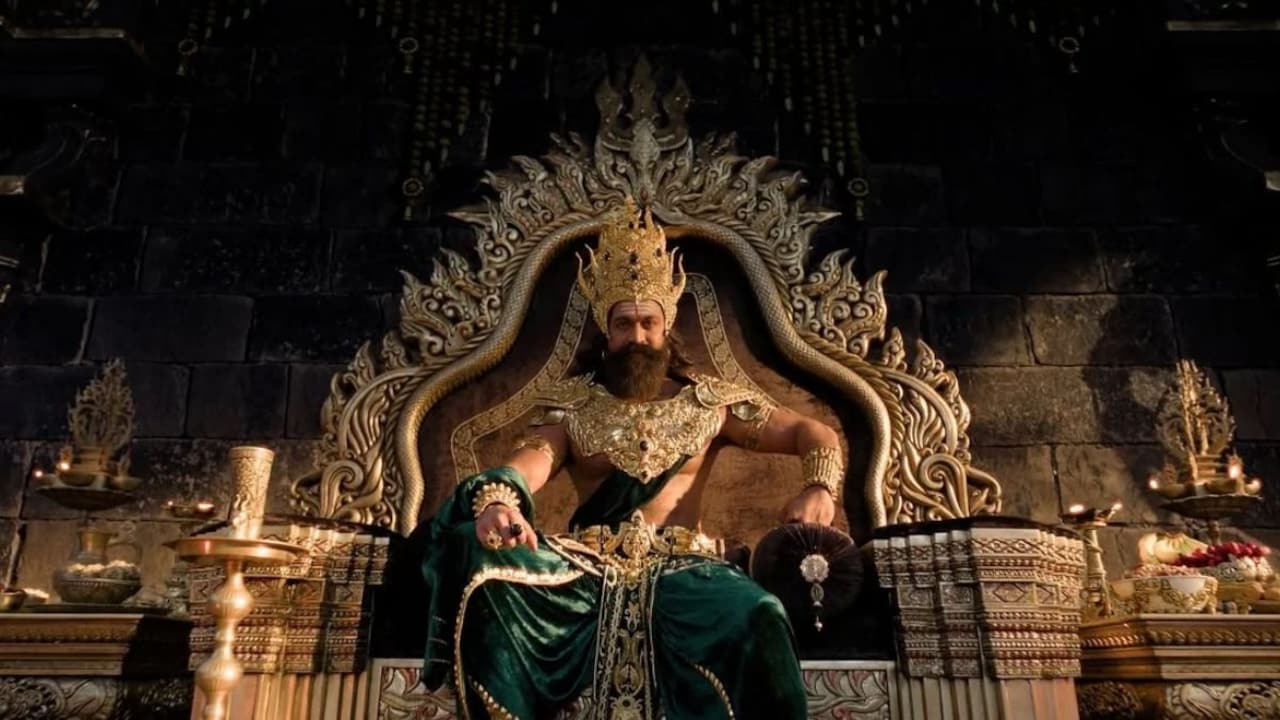
Knowing that the makers of Ramayana: Rise of A Legend wanted to appeal to global audiences, I expected a reshaping of familiar arcs, even through a modern lens. But as a cinema enthusiast, nothing surprised me more than the fresh, unexpected build-up given to Ravana (a superb Yash). Far from the cardboard-cutout tyrant of most past adaptations, here his character is considerably more layered.
Honestly, for the first two-plus hours, Ravana almost comes across as a socialist antihero championing women's dignity. A socialist-feminist Ravana? Is that even a thing? Am I overthinking this? Let's break it down.
The Curious Rebranding - Did Ravana Just Get A Socialist Makeover?
Spoiler warning activated. Key scenes are discussed below (though, to be fair, the source material has been out for a few thousand years).
Ramayana: Rise of A Legend's grand opening sequence establishes the timeless battle between the Devas and Asuras. It also sets up the holy trinity of Hinduism: Brahma the creator, Vishnu the preserver, Shiva the destroyer, and their constant struggle to maintain the cosmic balance.
The Asuras are defeated in the battle. And here's where the narrative (and visuals) get intriguing.
The defeated Asuras are pushed down to literally society's bottom tier- literally the rasatal (realm below the earth). They appear to be a completely defeated, oppressed community struggling for even food and dignity.
Kaikeshi, Ravana's warrior mother, blames and curses Lord Vishnu for constantly siding with the Devas. Ravana is introduced against this backdrop of systemic oppression. He is reminded by his mother about his responsibility towards his people and the legacy he must reclaim.
Ravana, the gifted musician and Veena player, obliges and goes for a long, intense tapasya. He finally gets a god-tier upgrade and unbridled powers from Brahma. He comes back to overthrow Kuber, the ruler of Lanka. What follows is perhaps an interesting political statement in the film. Ravana views himself as an equaliser, dismantling the long-established system of the Devas. More importantly, unlike the earlier, conventional depictions as a cruel emperor or his standard villainy, Ravana launches a full-blown welfare state in his booming and dominating voice (by Sharad Kelkar, who was also the voice of Prabhas in the Hindi Baahubali).
In his first address as the king of Lanka, he announces to his subjects that they will enjoy the same food, wealth, comforts, and privileges that he enjoys as their king:
"Tum mein se koi bhi na bhookha rahega na laachaar (None of you will go hungry or helpless).
Jo main khaaoonga, wahi tum khaaoge (What I eat, you shall eat)
Jaise main rahoonga, waise hi tum rahoge (How I live, you shall live)
Agar mera rajbhawan sone ka hoga, to tumhara ghar bhi sone ka hoga." (If my palace is made of gold, then your home too shall be made of gold.)
Anyone unfamiliar with the Ramayana, especially Western audiences who are meeting Ravana for the first time, could easily get the 'first impression' of a man shaped by social exclusion, a benevolent socialist king or a hero of a revolution, rather than the ultimate epic villain.
It is a fascinating set-up, and it gets better.
In one crucial scene, Ravana's brother-in-law mistreats a female servant carrying drinks. Ravana's response is extraordinary. He first shows respect towards the female, challenges his brother-in-law to a duel, and kills him. Ironically, this is also the first time the film calls Ravana ahankari (arrogant), a supreme flaw traditionally used to define his character across scriptures. But watching the sequence, you can't help but feel the brother-in-law was the real ahankari, while Ravana just earned major moral high ground as a champion of women.
I am no expert on the ancient texts, but traditional lore and past screen adaptations are packed with episodes of Ravana's unhinged arrogance. He terrorised sages, looted kingdoms and killed people, but those awkward resume items are left off his screen bio here. At least, until he abducts Sita and steps into his role as the ultimate villain.
Even there, the context of the motive is carefully layered. In many past retellings, Ravana's sister Surpanakha was shown to be a comic or grotesque caricature whose humiliation served as a major plot device for the conflict. Here, she is given agency matching the film's standout modern approach to female characters (which includes showing Sita as a warrior queen). Surpanakha's disfigurement by Lakshman is what truly ignites Ravana.
Infact, Sita actively calls out Lakshman for attacking Surpanakha, subtly deviating from the versions popular across India.
While older adaptations often framed the abduction around Ravana's own desire for Sita (sparked by Surpanakha's description of her beauty), here his motive is rooted mainly in his sister's dishonour. In standing up for the dignity of one woman, Ravana inflicts an unforgivable violation on another, and that's what erases the moral high ground the character had build up to that point.
Ranbir's Restrained, Anti-Outrage Armour As Ram
Debates are on over Ranbir Kapoor's Ram. Many are dismissing it as a one-expression performance with minimal emotional display. But he seems to be borrowing heavily from India's ultimate screen-Ram, Arun Govil (who plays King Dashrath here). Given his acting range, fans naturally expected more fire from Ranbir. Ravi Dubey's excellent Lakshman is being praised as the more human, relatable brother thanks to his cheeky lines.
But then, walking into the role of Lord Ram (or any religious/cultural figure) in today's hypersensitive times is a landmine. One wrong creative choice can trigger a campaign accusing you of destroying a nation's faith. Ranbir playing it safe (likely steered by the makers) with a serene smile, steady patience and suppressed emotions was likely a calculated defence mechanism. Criticism for a restrained performance is infinitely better than triggering a 24/7 outrage cycle and getting cancelled by the mobs. Just ask the team behind Adipurush.
When the script allows Ranbir Kapoor to drop the shield, like his parting words to Kaikeyi or his declaration of war on Ravana, the brilliance flashes through.
Sita's Amnesia?
Also, the pre-release noise around Sai Pallavi's casting as Sita dissolved instantly on screen. She gives a quiet, stubborn dignity to the role and fits right into the film's modern female-forward take.
Though, as a viewer, I felt slightly disappointed during the grand action sequence on the Pushpak Viman. Visually, it is a magnificent set piece. But while Jatayu is giving full superhero energy, why does Sita simply stand there offering moral support and terrified expressions? Is she simply forgetting that the film has already established her warrior credentials in a fabulous action scene? She must have taken a decent swing at Ravana. Hai na?
That said, the foundation of Ramayana: Rise of A Legend is solid. I am holding out for part two to see Ranbir fully uncoil, and of course, to see Sunny Deol bring his signature firepower to Hanuman.
As the credits rolled, my UK-born friend turned to me and smiled, "So Part 2 is basically going to be our own Avengers in Lanka!"
Hard to argue with that logic.