



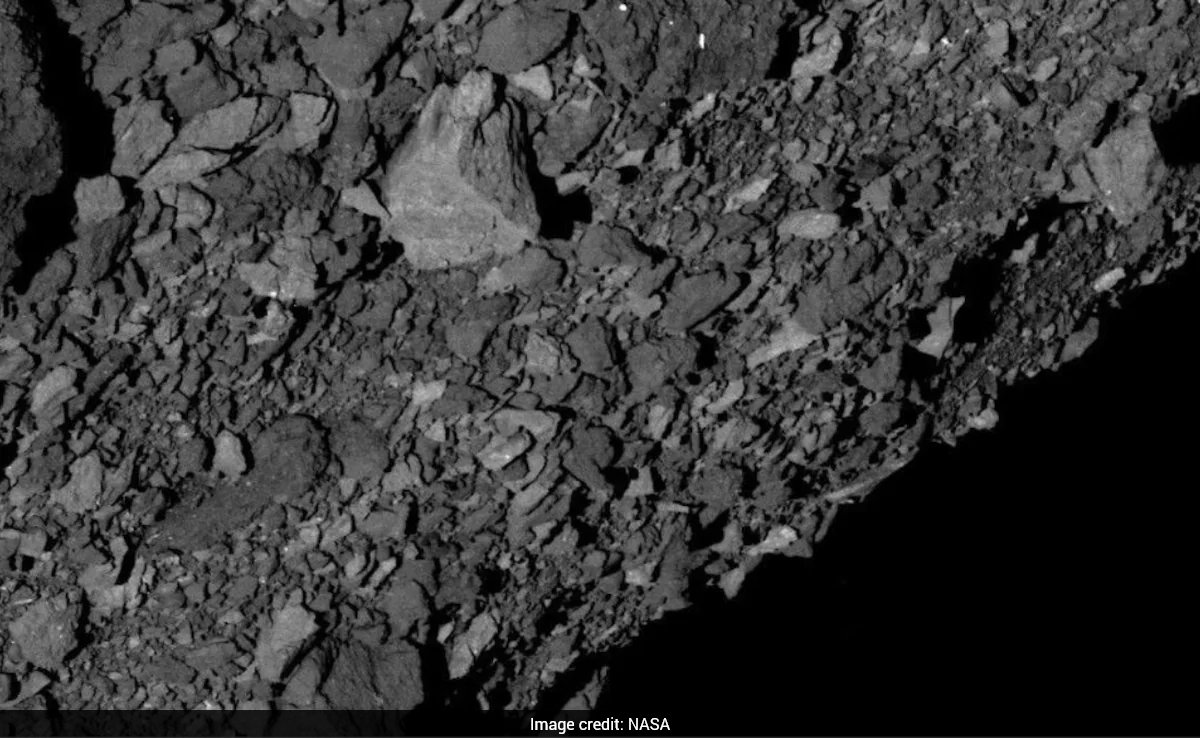
- Tryptophan, vital for serotonin production, was found in asteroid Bennu samples
- Bennu samples contain 14 protein-forming amino acids and all five nucleobases
- This supports the idea asteroids could have delivered life's building blocks to Earth
When the OSIRIS-REx spacecraft delivered samples from the asteroid Bennu to Earth, scientists were ecstatic, but who would have thought they would find a source of happiness (quite literally) in these samples?
A molecule crucial for producing serotonin, often referred to as the "happy hormone," has been detected in samples. For the first time, tryptophan, which is an essential amino acid, has been identified in extraterrestrial material.
Notably, tryptophan plays a crucial role in regulating mood, sleep and digestion in humans, and its presence in Bennu's sample suggests that asteroids could have delivered life's building blocks to early Earth.
"Our findings expand the evidence that prebiotic organic molecules can form within primitive accreting planetary bodies and could have been delivered via impacts to the early Earth and other Solar System bodies, potentially contributing to the origins of life," a team of scientists led by geochemist Angel Mojarro of NASA's Goddard Space Flight Center wrote in a paper published in Proceedings of the National Academy of Sciences (PNAS).
Also Read | Breathtaking Image Shows Colours Of Earth's Atmosphere As Seen From Space
What Are The Three Key Findings?
1. A faint signal for tryptophan was detected in Bennu's sample, confirming its presence alongside 14 other protein-forming amino acids.
2. Bennu's sample contains 14 of the 20 amino acids used by life on Earth and all five nucleobases (adenine, guanine, cytosine, thymine, and uracil)/
3. This discovery supports the theory that asteroids could have seeded life on Earth with prebiotic molecules.
Also Read | Brazilian Teenager, Who Wanted To Work With Animals, Mauled To Death By Lion At Zoo
What Do We Know About Asteroid Bennu?
As per NASA, the rocks of Bennu formed nearly 4.6 billion years ago on a primordial world, which has since been destroyed by a massive collision.
"Bennu coalesced from a small portion of the leftover rubble about 1 to 2 billion years ago," NASA stated.
The sample returned to Earth on September 24, 2023. After dropping off the sample capsule through Earth's atmosphere, the spacecraft was renamed OSIRIS-APEX and sent on a new mission to explore asteroid Apophis in 2029.
Track Latest News Live on NDTV.com and get news updates from India and around the world

