Opinion | Are Saudi Arabia And UAE Reuniting Again After 10 Years?
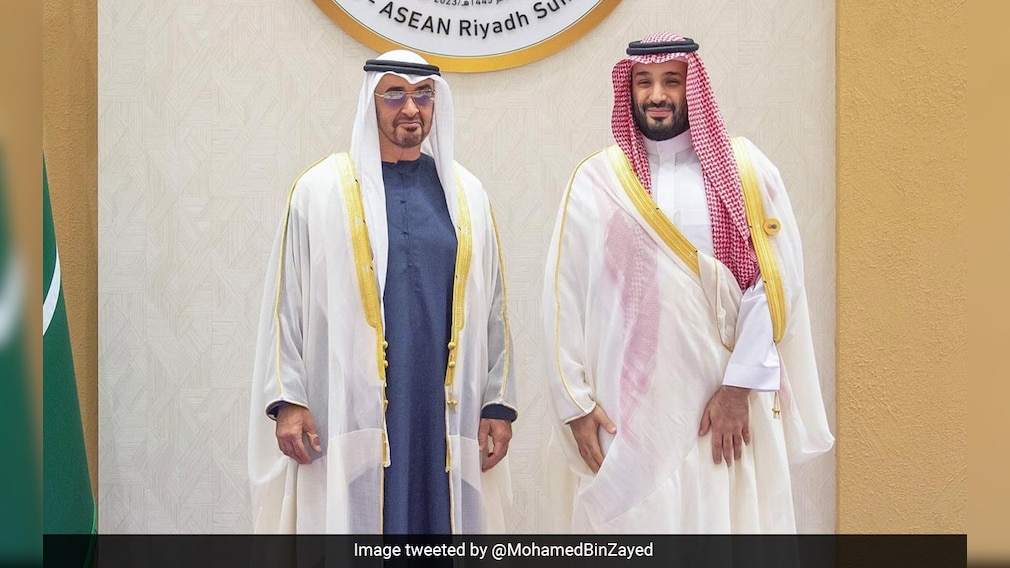
On Tuesday, the UAE's Vice President, Deputy Prime Minister and Chairman of the Presidential Court, Mansour bin Zayed, met Saudi Crown Prince Mohammed bin Salman.
Are we witnessing a rapprochement between the Kingdom of Saudi Arabia (KSA) and the United Arab Emirates (UAE)?
It certainly seems so. On Tuesday, the UAE's Vice President, Deputy Prime Minister and Chairman of the Presidential Court, Mansour bin Zayed, met Saudi Crown Prince Mohammed bin Salman. He was accompanied by a high-level delegation, which included Prince Khalid bin Salman, the Saudi Minister of Defence, Ali Al Shamsi, Secretary General of the Supreme Council for National Security; Ali Al Neyadi, Chairman of the National Emergency, Crisis and Disaster Management Authority and others.
The UAE's main national daily, The National, described the meeting thus: "The visit reflects the deep and enduring partnership between Riyadh and Abu Dhabi, which have maintained close political, economic and security co-operation. High-level exchanges between the two countries are a regular feature of Gulf diplomacy, with senior officials frequently travelling between the two capitals to co-ordinate positions on matters of shared concern."
It would seem as if the two have been best-friends-forever; there was no allusion to the strain that the bilateral relationship had come under due to divergent views on a range of issues, including the one plaguing the Saudis currently the most: Yemen.
Both Saudi Arabia and the UAE had once been partners in Yemen as they intervened to prop up the government of President Abdur Hadi Mansour against the Iran-backed Houthis. Over the years, however, both Gulf powers came to back different factions in Yemen, with the Saudis backing the Yemen government, and the UAE supporting the Southern Transitional Council (STC). Once the UAE felt that the southern regions, including the port of Hodeidah, were secure, it signalled its withdrawal from the war, while the Saudis wanted to secure all of Yemen from the Houthis.
Differences had piled up on other subjects too - on Sudan, on Iran, and even on the economic front, with their competing visions for future prosperity, with the UAE taking the big bold step of exiting from the Saudi-led Organisation of Petroleum Exporting Countries. Another factor has been regarding the normalisation of ties with Israel. While the UAE became the first Israeli partner under the Abraham Accords, the Saudis held back. Now, under the same Houthi threat, Saudi Arabia preferred to turn to Pakistan and not long ago rival Turkey, but not to Israel.
Is that about to change now?
Interestingly, bin Zayed's Saudi visit came almost on the heels of Israeli Prime Minister Benjamin Netanyahu 's visit to Abu Dhabi on Sunday, September 27. While officially it was to discuss bilateral ties, Israeli media announced that officials from other Arab states, including Saudi Arabia were also present at the meeting, which had reportedly also discussed regional escalation and creating a regional defence architecture against "shared threats", with a specific focus on Iran and the Houthis.
Indeed, the Kingdom has seen unprecedented attacks earlier by Iran, which targeted American bases on its territory, and then by Iran-backed Iraqi militias, and now the Yemeni Ansarallah, also majorly backed by Iran. While Iran has inflicted major economic costs on Gulf countries, including on Saudi Arabia, not only through military action but also by closing the Strait of Hormuz, the Houthis have been targeting both Saudi shipping as well as sensitive and strategic infrastructure such as the Petroline oil pipeline. The Saudis are back to facing the same nightmare they had suffered just a decade ago in Yemen, from which they had extricated themselves in 2022 with great difficulty. Now they are back, threatening not just the Kingdom but others, too.
Earlier this year, the Saudis established a multinational maritime defence alliance to "enhance maritime security, protect shared interests in international sea lanes, and prevent their exploitation as a tool of political or economic pressure”, according to Crown Prince Mohammed bin Salman. That did not deter the Houthis. Riyadh then went on to sign the Mecca Pact with Pakistan and Turkey, which was slated to be a major deterrent and was meant to promote regional security and stability. The Houthis soon laid bare the reality of that deterrence. The Saudis next turned to the US, which, while agreeing to intelligence-sharing and coordination, has ruled out any military intervention against the Houthis. The Saudis have also asked China to help rein in the militia group by leveraging their relationship with Iran.
Perhaps it now wants to invoke Gulf solidarity and cooperation. Yesterday, addressing the Kingdom's Shura Council, the Crown Prince said, “The attacks targeting the Gulf Co-operation Council states underscore that Gulf security and stability are indivisible … We are working with our brothers to safeguard Gulf security, pursue strategic co-operation and economic integration, and continue … strengthening joint Gulf action, in order to achieve the GCC's goals and meet the aspirations of its citizens."
Here, the UAE would be an anchor, as the policies of both had earlier converged on a wide range of issues, from reining in the Muslim Brotherhood to modernisation, from Syria to Qatar (remember the blockade?), to Turkey. While the UAE remains deeply sceptical of President Erdogan 's Islamist orientation, the Saudis tried to co-opt it through the Mecca Pact. In fact, President Mohammed bin Zayed was considered to have been a mentor of sorts to Mohammed bin Salman, and there was a time when they had also been mulling joining the Abraham Accords.
Steps have been taken earlier to reach out to each other. For instance, in July, Saudi Arabia's Sheikh Abdulla Al Hamed, chairman of the National Media Authority, wrote on X, "Emirati-Saudi relations are an extension of a shared history and deep-rooted fraternal ties between two brotherly peoples united by a single destiny." Then in August, President Sheikh Mohamed sent a letter to Saudi Arabia's King Salman, inviting him to attend the UN Water Conference in Abu Dhabi in December.
Meanwhile, Saudi Arabia 's Foreign Minister, Prince Faisal bin Farhan, was in the US for talks on regional security and the Iran war. By all accounts, the Saudis are averse to intervening once again in Yemen, or for military action again in the region; what they are seeking, however, is to keep up the economic pressure on Iran, which would, in turn,m weaken its support for its proxies.
While the Gulf Cooperation Council (GCC) was formed as an attempt to forge a unified response to Iran's Islamic revolution of 1979, and frame future policy, it has not been able to forge an adequate unified response to the US-Israel war on Iran, to which they have become collateral damage. Iran has revealed the limitations of a US security architecture for the Gulf countries, and the Houthis have revealed the limitations of Saudi-led security initiatives.
In this context, it is quite logical for the Saudis and the UAE - the two most active GCC members who have tried to proactively shape regional policies - to once again join forces and align themselves towards a common goal. Joint GCC pressure on the US to keep up the economic pressure may work better than individual Saudi or UAE demands. At the same time, if the Saudis do truly feel the need to seek Israeli cooperation in intelligence-sharing or surveillance without joining the Abraham Accords, then the UAE can provide the shield for that. Therefore, what we may be witnessing now may be the beginning of another rapprochement process in the region.
(The author is a senior journalist)
Disclaimer: These are the personal opinions of the author
-
In Sonia Gandhi's 'Belonging', The Delhi Of 'Chashme Buddoor': How A Lost City Is A Character In Both

Sonia Gandhi's book describes a cityscape through which Siddharth (Farooq Sheikh) rides a motorbike in Paranjpye's cult movie. A city of quiet roads, ice cream at India Gate, and a life that lost a race it couldn't opt out of.
-
Opinion | History Is Repeating Itself In Rawalkot, And India Should Be Worried
This very area had twice been the setting for rebellions in the past, including in 1947. Another one is playing out violently now
-
Asaduddin Owaisi Seals Chandrashekhar Azad Tie-Up, Chief Minister Face. What It Means For UP
Owaisi had, for months, sought space in the Opposition alliance, even issuing ultimatums to the SP and the Congress. However, his overtures failed to find takers.
-
Jensen Huang Controversy Raises Questions About Celebrity CEOs
A flamboyant CEO can build a great company. But a great company should never have to depend on the CEO being infallible.
-
Opinion | Sonia Gandhi Belongs Here, And She Wants Us To Know That
Sonia Gandhi was easily the most misunderstood person in Indian politics. I believe Belonging is her way of telling us who she really was and is, writes Sanjay Jha.
-
4,500 vs 34,000: NASA Scientist Flags Punjab-Haryana Farm Fires Undercount
Dr Hiren Jethva, an aerosol remote sensing scientist associated with Morgan State University and NASA's Goddard Space Flight Centre, stated that his calculations showed 34,000 farm fires in Punjab and Haryana between October 1 and November 9 this year.
-
Analysis | Politics Of Drugs: BJP Looks To Turn Punjab AAP's Biggest Challenge Into Electoral Gains
The BJP is attempting to turn the drug menace into one of its principal political weapons against the AAP government in Punjab, ahead of the assembly election