

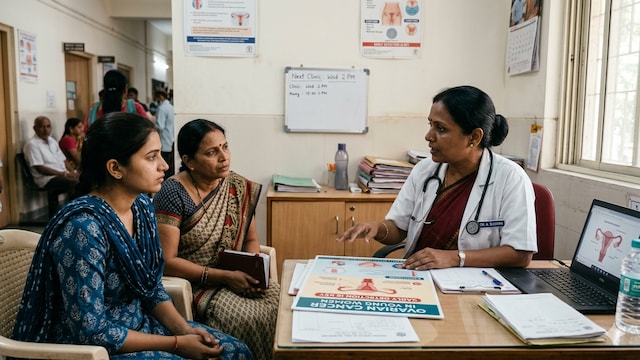
"Sometimes, the most powerful thing said in an oncology consultation is not the diagnosis. It is the silence after it." You see, Cancer changes language.
Before oncology enters a person's life, words like "scan," "marker," "mass," "spread," and "biopsy" belong to medicine; something you hear in passing or read about. Once the diagnosis is made, it begins to belong to emotion, like how a CT report becomes capable of ruining sleep, a delayed callback acquires catastrophic meaning or how even the doctor's pause while reading a report can alter a patient's heartbeat.
Modern oncology is usually discussed through molecules, mutations, immunotherapy, survival curves, and protocols. Yet beneath the science lies another invisible force quietly influencing outcomes - psychology. Not in the simplistic sense of "positive thinking cures cancer", which is both scientifically false and emotionally cruel. Rather, psychology in the deeper human sense: expectation, fear, attachment, trust, interpretation, and meaning.
Cancer is never experienced only in the body. It is also experienced in relationships.
The Nocebo Effect: When Fear Becomes Physiology
Most people have heard of the placebo effect - improvement caused partly by positive expectation. Far fewer understand its darker twin: the nocebo effect which occurs when negative expectations themselves worsen suffering.
An oncology patient told, "This chemotherapy is extremely difficult," may experience greater nausea, fatigue, pain, and anxiety than another patient receiving the same drug explained with calm realism, reassurance and routine counselling. The medicine has not changed but the body's anticipation has.
The brain does not observe illness passively, in contrast, it actively shapes pain, stress physiology, immune responses, symptom perception, and treatment outcomes through expectations, beliefs, and meaning-making processes. For example, a patient awaiting chemotherapy often begins feeling nauseous before the infusion starts or sometimes merely entering the hospital corridor is enough to trigger sweating, retching, palpitations, or exhaustion. This is not "drama", but conditioned neurobiology since the body learns fear.
Another Invisible Force: The Pygmalion Effect
But oncology is influenced not only by what patients believe about treatment, it is also influenced by what people around the patient unconsciously begin to expect from them. Psychology calls this the Pygmalion Effect - the phenomenon where expectations subtly shape outcomes.
For example, in schools, children perform differently depending on what teachers unconsciously expect from them. In hospitals, something similar can quietly unfold. A patient repeatedly treated as fragile, hopeless, or "terminal" may gradually begin inhabiting that emotional identity. Families begin speaking in softer tones, friends stop discussing the future or conversations shrink. The patient slowly transitions from being a person living with cancer to becoming "the cancer patient."
Expectations become environmental.
On the other hand, when clinicians communicate realism without emotional abandonment, something remarkable happens. Patients often tolerate treatment better, maintain greater agency, report less distress, and remain psychologically engaged with life.
Hope is not denial; it is nervous system regulation.
The Consultation Room Is Also a Psychological Space
An oncology consultation is never merely an exchange of information. It is a psychological event. The doctor may believe he is discussing survival percentages when in fact the patient may hear a prophecy about whether life remains worth planning.
The physician may say: "We will try our best." And the patient may internally hear: "This is hopeless." The oncologist may mention side effects responsibly whereas the patient may begin monitoring every sensation with hypervigilance where a minor gastric discomfort becomes "the cancer spreading" or a headache becomes "brain metastasis" and a delayed report becomes catastrophe.
Cancer creates interpretative hypersensitivity.
The human mind, under threat, stops processing information neutrally and becomes exquisitely tuned toward danger detection. Evolution designed the brain to overreact during uncertainty because anxious ancestors survived better than relaxed ones. Unfortunately, oncology is built almost entirely from uncertainty.
The Emotional Geometry of Oncology
Every cancer consultation contains three invisible relationships:
- The patient's relationship with disease.
- The patient's relationship with the doctor.
- The patient's relationship with their own future.
- The patient's relationship with their family.
- Often, the second relationship quietly shapes the other two.
A trusted oncologist becomes more than a technical expert. He or she becomes a psychological anchor against chaos not because doctors possess magical powers, but because the human nervous system regulates itself through perceived safety and connection. This is why emotionally cold communication can sometimes worsen suffering even when medically accurate. A scan result delivered without humanity may linger in memory longer than the scan itself.
The Internet and the Manufacturing of Fear
Modern oncology patients rarely enter consultations psychologically untouched. Thanks to internet, before meeting the doctor, many have already:
- searched survival statistics,
- watched traumatic YouTube videos,
- joined fear-driven forums,
- read miracle cure claims,
- encountered misinformation about chemotherapy,
- or consumed stories presented without context.
The internet has democratized information but also industrialized anxiety. One patient reads: "Chemotherapy destroys the body." Another reads: "Doctors hide the real cure." A third sees:
"My uncle took chemotherapy and died in two months."
The human brain is poor at statistical reasoning but excellent at emotional storytelling where one vivid anecdote outweighs ten clinical trials. Fear spreads faster than evidence because fear feels urgent.
The Burden on Doctors
Oncology doctors occupy one of the heaviest emotional positions in medicine. Patients often seek from them something medicine cannot honestly provide: certainty. But cancer medicine operates through probabilities, not guarantees. Doctors must therefore perform an extraordinarily difficult balancing act:
- communicate seriousness without destroying hope,
- discuss side effects without amplifying nocebo responses,
- remain compassionate without becoming emotionally consumed,
- and maintain scientific honesty in situations where certainty rarely exists.
This psychological labour is invisible but exhausting. An oncologist may spend years learning molecular pathways and targeted therapies, only to discover that one of the most important therapeutic tools remains communication.
Healing Is Not Only Cellular
None of this means emotions "cause" or "cure" cancer in simplistic ways. But human beings are biopsychosocial organisms where the nervous system, endocrine system, immune system, behaviour, sleep, stress regulation, relationships, and meaning-making constantly interact with illness.
Two patients may receive identical chemotherapy but live through entirely different illnesses psychologically: One experiences medicine as punishment whereas other experiences it as partnership. One enters the infusion room with terror; the other enters with trust. The disease may be the same but the internal experience is not.
The Final Paradox
Cancer treatment often requires patients to place extraordinary trust in strangers during the most vulnerable period of their lives. They must allow toxic drugs into their veins believing those drugs may save them, must tolerate uncertainty while desperately craving certainty, must remain hopeful without becoming delusional and also search for information without drowning in it.
And doctors, too, must continue carrying hope responsibly without offering false promises.
Perhaps this is the deepest truth of medicine: the doctor-patient relationship is not separate from treatment and in many ways, it becomes part of the treatment itself.
Medicine fights the disease. But trust, communication, meaning, and emotional safety often determine how human beings survive the experience of having one.
(By Dr. Sushma Gopalan, Lead Consultant - Child Life Services (Psychology), Manipal Hospital Yelahanka)
Disclaimer: The opinions expressed within this article are the personal opinions of the author. NDTV is not responsible for the accuracy, completeness, suitability, or validity of any information on this article. All information is provided on an as-is basis. The information, facts or opinions appearing in the article do not reflect the views of NDTV and NDTV does not assume any responsibility or liability for the same.