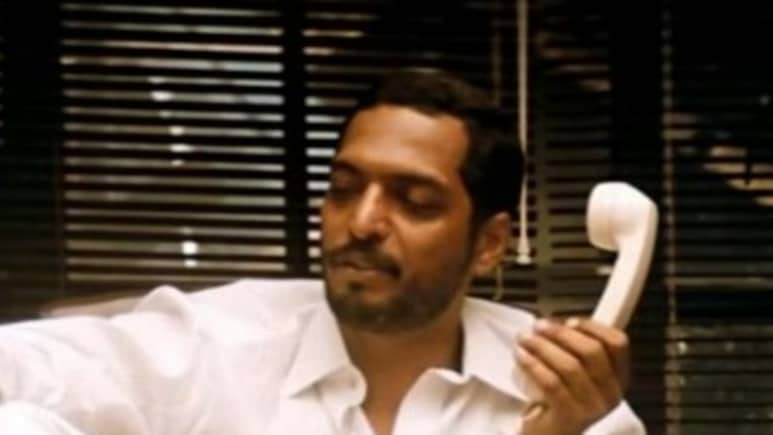
There are villains you remember because of the way they kill. And then there are villains who make you nervous even when they are doing absolutely nothing. Nana Patekar as Anna in Parinda belongs firmly to the second category.
I recently rewatched the 1989 crime drama, and somewhere between his unsettling expressions, sudden bursts of rage and disturbingly casual approach to violence, I understood why his performance continues to haunt people decades later.
Honestly, if you think today's cinematic villains are scary, wait until you meet a man who can make your stomach drop simply by looking at someone.
Nana Patekar died on Thursday, October 8, and revisiting one of his most memorable performances brings a different kind of emotion to the viewing experience. But Parinda deserves to be revisited for more than nostalgia.
It is a crime drama that helped change the way Hindi cinema looked at the Mumbai underworld, even if some aspects of its storytelling feel dated today. And at the centre of it all is a performance that understands something many screen villains still struggle with: fear doesn't always announce itself.
Anna Is The Kind Of Villain Who Makes You Nervous In Advance
Let's get one thing straight. Anna isn't frightening because he is constantly shouting, threatening people or throwing punches. He is frightening because you never quite know what he is going to do next.
Watch Nana's face when Anna listens to someone. Notice the sudden shifts in his expressions, the pauses that stretch just long enough to become uncomfortable, and the way his mood can change before the person standing opposite him has even understood what went wrong.
His menace lies in that unpredictability. One moment, he seems almost amused; the next, you are reminded that this is a man capable of extraordinary cruelty.
The background score doesn't have to tell you that something is wrong. Nana's face already has.
What makes the performance particularly effective is that Anna doesn't feel like a villain performing villainy for the audience. He behaves as though the world around him is entirely normal, even when his actions are anything but. His authority is so deeply established that the people around him seem to anticipate danger before he even makes a move.
Gen Z might call it an aura. But this is the kind of aura that makes you want to leave the room.
The character also earned Nana his first National Film Award for Best Supporting Actor. Watching the film now, it is easy to see why the performance became such a defining part of his career.
But Anna's menace works because Parinda doesn't build its world around a villain alone. His power has consequences for everyone around him, particularly two brothers whose relationship becomes the film's emotional centre.
Jackie Shroff And Anil Kapoor Give The Story Its Emotional Core
Directed by Vidhu Vinod Chopra, Parinda follows two brothers, Kishan (Jackie Shroff) and Karan (Anil Kapoor), whose lives take different turns in the same violent underworld.
Kishan is already involved with the criminal world, while Karan returns from abroad hoping to build a future away from it. Their relationship becomes the emotional backbone of the film, forcing both brothers to confront the cost of loyalty when their personal lives collide with the consequences of crime.
Jackie Shroff brings a certain weariness to Kishan, a man whose choices have trapped him in circumstances he cannot easily escape. Anil Kapoor, meanwhile, gives Karan the idealism and emotional urgency the story needs. Their performances make the brothers' bond believable without pretending that love alone can undo the damage around them.
Anupam Kher's Prakash, Karan's police officer friend, also plays an important role in shaping the film's emotional stakes. His fate makes the consequences of the underworld painfully personal, pushing the story beyond a simple conflict between gangsters and those who oppose them.
What I appreciate about Parinda is that it doesn't treat the brothers' relationship as a convenient excuse for dramatic confrontations. Their choices have consequences, and those consequences keep accumulating. The film understands that sometimes the people you love most are also the people whose decisions can hurt you the most.
A Crime Drama That Doesn't Try To Make Gangsters Look Cool
A lot of crime films invite audiences to admire the power, money and swagger that come with a life outside the law. Parinda is considerably less interested in selling that fantasy.
Its Mumbai is a world of cramped spaces, shadowy interiors and streets where violence can intrude on ordinary life without warning. Binod Pradhan's cinematography gives the film much of its oppressive atmosphere, using lighting and framing to make the city feel like a place from which escape is never quite guaranteed.
The violence, too, has consequences. It damages relationships, destroys lives and leaves the surviving characters with decisions they cannot simply walk away from.
Rather than treating every confrontation as an opportunity for spectacle, Chopra often lets the emotional aftermath do the heavier lifting.
This is one reason the film still feels significant. Released in 1989, Parinda offered a markedly grim vision of the underworld, moving away from the more theatrical treatment of crime that audiences had often encountered in mainstream Hindi cinema.
Its influence can be felt in later gangster dramas, including Satya and Company, which explored the criminal world through their own distinct storytelling styles.
That said, Parinda isn't completely free of familiar cinematic conventions. Its dramatic confrontations and heightened emotional moments can occasionally feel rooted in the melodramatic traditions it otherwise tries to move beyond.
The film is at its strongest when it trusts its characters, atmosphere and performances; when it leans heavily on heightened tragedy, the storytelling can feel less subtle.
Still, for a film made in 1989, its willingness to portray crime as ugly, claustrophobic and emotionally destructive remains impressive.
Where Parinda Shows Its Age
Not everything about Parinda works equally well today, and its reputation shouldn't make it immune to criticism.
For one, the pacing can feel uneven. The film takes its time establishing its world and relationships, which helps build atmosphere but occasionally slows the momentum.
Viewers accustomed to contemporary crime dramas that move quickly between revelations, conflicts and action sequences may find some stretches a little drawn out.
The treatment of its female characters is another limitation. Paro (Madhuri Dixit) matters to the emotional stakes of Karan's story, but the narrative gives her comparatively little room to exist beyond her relationship with him and the events surrounding the men.
Her character could have benefited from a more developed perspective of her own. This doesn't erase Dixit's contribution, but it does reveal how narrowly the film frames the experiences of its women.
There are also moments when the emotional shifts feel abrupt. The film is effective at establishing the brothers' conflicting loyalties, but it sometimes moves through major developments without giving every character's internal transformation enough space to breathe.
Its commitment to tragedy can make the world feel relentlessly bleak, leaving little room for tonal variation.
These shortcomings don't undo the film's achievements.
For all its importance as a crime drama, Parinda ultimately depends on its characters to sustain its emotional weight.
Kishan's struggle is particularly compelling because his love for his younger brother exists alongside the compromises he has made.
Karan's idealism, meanwhile, is tested by a world in which good intentions offer little protection. Neither brother has the luxury of pretending that his choices affect only himself.
But Nana Patekar's Anna is the character who lingers in the mind long after the film ends.
What makes him memorable isn't simply his cruelty. It is the way Nana gives that cruelty a recognisable human form without making it sympathetic or excusing it. Anna doesn't need an elaborate backstory to justify every action, nor does the film need to turn him into a misunderstood antihero. He is a frightening man whose presence changes the atmosphere of every scene he occupies.
The performance is also remarkably economical. Nana doesn't need to dominate every exchange to remain the most unsettling person in the room. Even when other characters are speaking, you find yourself watching him, waiting to see whether his expression will change.
Nana makes those details look effortless, which is precisely why the performance is so effective.
So, Does Parinda Still Work For Gen Z?
Yes, although not every aspect of it has aged equally well. The pacing can feel slow, Paro (Madhuri Dixit) deserved more agency, and some of the emotional turns are less subtle than the film's reputation might suggest. But its performances, atmospheric filmmaking and refusal to romanticise violence give it an impact that goes beyond nostalgia.
And then there is Nana Patekar as Anna.
Rewatching Parinda after his death makes the performance more poignant, but it doesn't need sentiment to justify its place in Hindi cinema.
Parinda may not be a flawless film, but Anna is a character worth revisiting. And if there's one thing this rewatch reinforced for me, it's this: the villain doesn't need a background score to scare you. Sometimes, all he needs is a smile that makes you wish he hadn't smiled at all.
