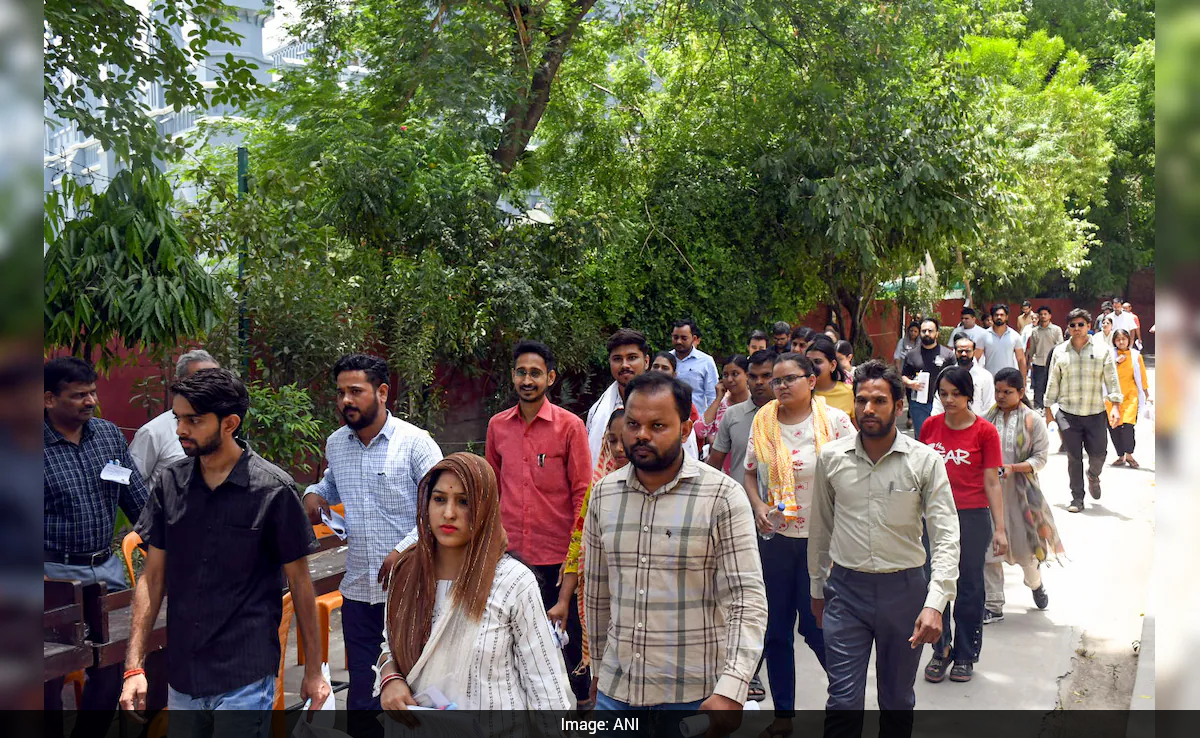
UPSC CSE 2026 Paper Analysis, Student Reactions: The Union Public Service Commission (UPSC) conducted the Civil Services Preliminary Examination (CSE) 2026 General Studies (GS) Paper 1 and Civil Services Aptitude Test (CSAT) Paper 2 today, May 24, for over eight lakh candidates across the country. Several aspirants described the GS Paper 1 as unusually lengthy and analytical in nature.
Anchal Tripathi, an aspirant, said the paper was "unusually lengthy" but manageable with adequate practice, adding that she attempted nearly 78 questions. Another candidate, Saurabh Kumar, said previous-year questions continued to help in preparation, although this year's paper reduced their direct advantage to some extent.
According to educators, the 2026 paper reflected a noticeable shift in UPSC's approach, with current affairs deeply integrated into core subjects instead of being asked separately. Experts also observed increasing emphasis on analytical thinking, constitutional understanding, digital economy themes, and application-based questions.
Subject-Wise Analysis By Educators
HISTORY
According to Dr. SP Shahi, the History section focused more on Ancient India and Art & Culture while Modern History had comparatively lesser weightage.
"History this year focused heavily on Ancient India and Art & Culture, including temple architecture, Harappan civilisation, Rigvedic period, Buddhism, Jainism, and Tamilakam. Modern History had limited weightage. The section tested conceptual clarity over factual recall and remained moderate to tough overall," said Dr. SP Shahi, History Faculty, Drishti IAS.
POLITY
Mr. Abhay Kumar said the polity section demanded precise constitutional and legal understanding with minimal scope for guesswork.
"The polity section shifted towards strict legal precision, testing candidates on constitutional provisions, parliamentary procedures, repealed Acts, and frameworks like BNSS 2023. The question pattern reduced guesswork and required a strong command of the Constitution," said Mr. Abhay Kumar, Polity Faculty, Drishti IAS.
ECONOMY
According to Dr. SP Jha, the Economy section reflected UPSC's growing focus on digital finance and emerging technologies.
"The economy section marked a shift from traditional macroeconomic theory towards digital finance and emerging technologies. Questions covered areas such as ONDC, Digital Rupee, RBI FI-Index, Sustainability Bonds, and modern banking ecosystems," said Dr. SP Jha, Economy Faculty, Drishti IAS.
GEOGRAPHY
Dr. VK Trivedi noted that Geography questions required analytical thinking and application-based understanding.
"This year, Geography demanded analytical depth with emphasis on geomorphology, climate, river systems, and strategic locations. Questions also linked geography with infrastructure and environmental themes, making rote learning insufficient," said Dr. VK Trivedi, Geography Faculty, Drishti IAS.
ENVIRONMENT & ECOLOGY
According to Dr. VK Trivedi, Environment & Ecology emerged as one of the most crucial sections in this year's paper.
"Environment & Ecology covered a wide range of biodiversity, conservation, and climate-related topics including REDD+, LT-LEDS, Madhav National Park, and FAO initiatives. The section was vast but moderate and required regular awareness of environmental current affairs," he said.
SCIENCE & TECHNOLOGY
Mr. Sanjay Pandey said the Science & Technology section heavily focused on recent technological developments and applied science.
"Science & Technology moved beyond basic concepts and focused on applied technologies and recent developments such as Green Hydrogen, Genome India, Quantum Mission, Blockchain, drone swarms, and the private space sector. The section was scoring for candidates who followed tech-related current affairs regularly," said Mr. Sanjay Pandey, Science & Technology Faculty, Drishti IAS.
CURRENT AFFAIRS
According to Mr. Vivek Rahi, current affairs in UPSC are no longer confined to a separate section and are now integrated across subjects.
"The traditional standalone current affairs section has effectively disappeared, with current developments now embedded across subjects like History, Geography, and Economy. UPSC expects candidates to integrate current affairs directly with the syllabus," said Mr. Vivek Rahi, Current Affairs Faculty, Drishti IAS.
